the story of my instruments
not every instrument called for me.
i can't wait to tell you about my instruments.
somewhere in my home there's a keyboard i haven't touched, a ukelele that hurt my fingers, and a flute i stopped blowing into. none of them made it into my practice. and yet here i am, with a collection i genuinely didn't plan and every single one has earned its place.
i didn't set out to build a collection. i'm not a musician in the traditional sense. i tried to learn music scores, but my brain couldn't keep up with both hands doing different things at the same time. i couldn't tune my voice to a C note on command because i wasn't listening to myself yet. for a long time, i genuinely believed making music was just not for me. haiya!
what changed wasn't skill. it was listening. not to the instrument, but to what happened in my body when i heard it.
i didn't realise until recently that this is my criterion. if something calls for me, if i feel it before i understand it, my ears and body sit up. if it doesn't, i leave it alone. no instrument in my practice is there because it was recommended, or because everyone else uses it, or because i read that it was supposed to work a certain way.
they're there because at some point, in some room, something shifted in me. and i couldn't unhear it.
it started with tuning forks. and a wind chime i hung in my living room.
the first sound tools i ever bought weren't bowls or gongs. they were tuning forks. small, unassuming, almost boring to look at.
what drew me in was precision. a tuning fork doesn't fill a room. it finds you. held close to the body, the vibration moves through tissue, not just air. it's intimate in a way that group instruments aren't. i use them now almost exclusively in private one-to-one sessions, because proximity matters. the closer the sound, the more specific the effect.
the solfeggio set i work with covers six frequencies, each with its own emotional territory. there's one at 396hz that works with fear and guilt, another at 528hz that has been called, with more marketing than science behind the name, honestly, the "love frequency." what i can tell you is that each fork lands differently in the body. not because of the label someone put on it, but because of what i notice in myself and in the people i sit with.
i also have the biosonic brain tuners, developed by dr. john beaulieu based on EEG brainwave research. these work through binaural beats, you sound one fork near each ear, and the brain integrates the difference between the two tones into a third, internal rhythm. delta for deep sleep. theta for the meditative, dreamy in-between. alpha for that relaxed-but-present quality. no chakra language needed here. it's neurological, not energetic. and for clients who are sceptical of the spiritual framing of sound work, this is often where the conversation opens up.
around the same time i bought the tuning forks, i hung a zaphir twilight wind chime in my living room. not for sessions. just for me. i loved that a breeze could make it sing. i still use it, most recently at a corporate sound session where the only other instrument was my handpan. one chime, one handpan, thirty women. and it was enough.
then came the handpan. and everything changed.
i've written elsewhere about my first encounter with sound, lying on a mat in bali, the gongs washing through me, the unusual quiet that followed. but the handpan came from a different direction entirely.
i had tried guitar (my fingers disagreed). piano (my left hand simply refused to cooperate with my right). drums (my brain buffered at "boots and cats"). i had quietly concluded that making music was not for me.
so i decided to try my hands on a handpan.
i didn't know what i was doing. i just touched it. and what came out was... something. not skill. not performance. just sound that met me where i was. the handpan is forgiving. yes, it still requires two hands, sometimes doing different things, sometimes the same. but it doesn't demand you've mastered the rules before it gives you something beautiful back. it responds to what you bring.
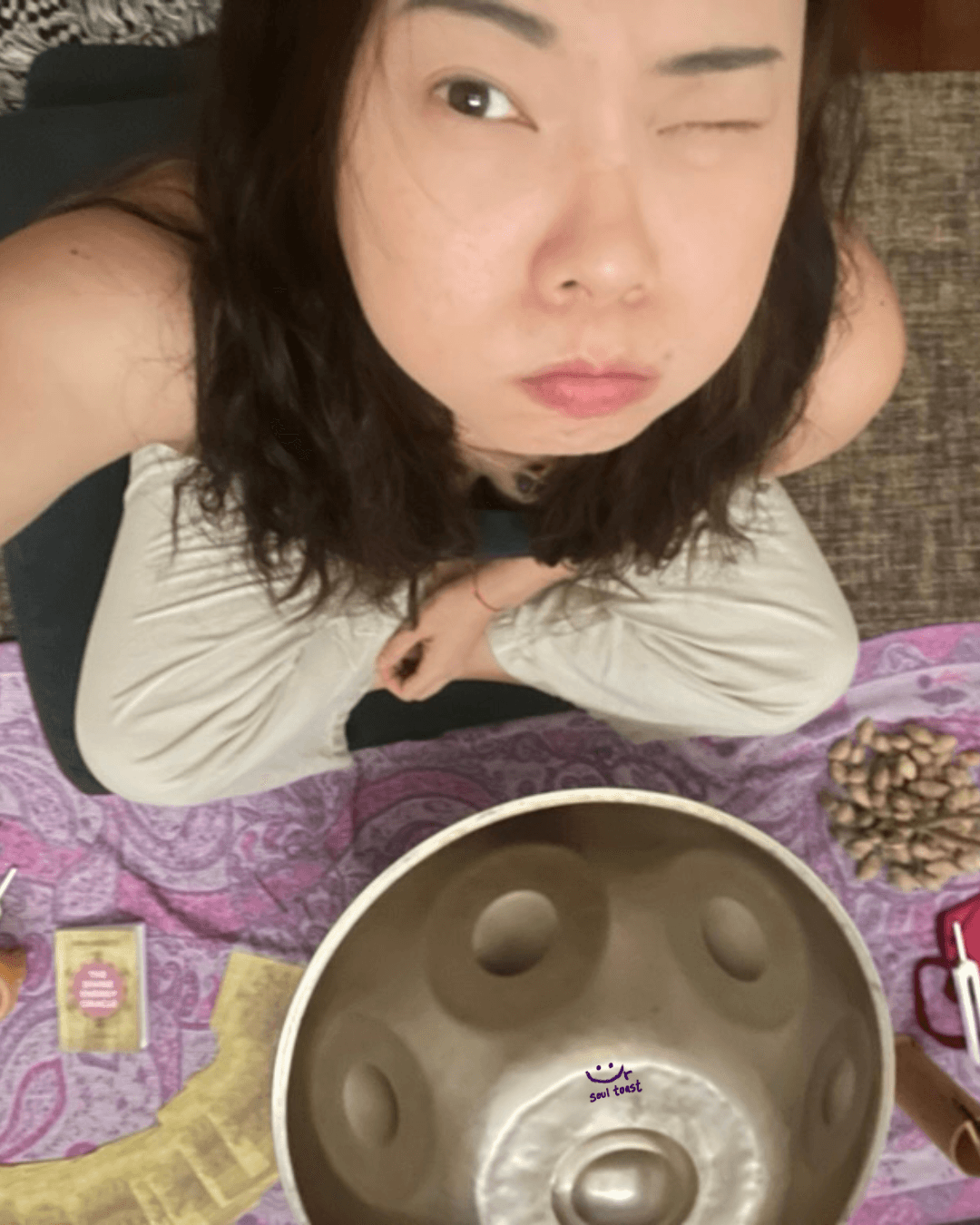
the one i play is a battiloro F# pygmy, 432hz: nine notes, pentatonic minor, earthy, hypnotic, with a long sustain that keeps ringing after your hands have lifted. i took it over from antonio, a handpan master based in singapore who carried it all the way from italy. (my other handpan, an edelweiss D kurd with 18 notes, also came from him - a different character entirely, warmer and more melodically complex. more on that another time.)
432hz versus the standard 440hz: i want to be honest here. there are some discussions online about 432hz being the "natural frequency of the earth" or somehow more healing than 440hz. some of this is marketing, not science. what i've found is that the combination of the F# pygmy scale and the 432hz tuning creates something that feels softer, gentler, more suited to a meditative practice. but that doesn't mean a 440hz handpan can't do the same! my D kurd at 440hz takes people somewhere completely different. cosmic, expansive, almost interstellar. both are valid. both serve.
i started playing the F# pygmy weekly at space2b, alongside their venue gongs, in a session called rooted in sound. that combination, handpan over sustained gong, became the sound i think of when i think of what i do. the gong holds the floor. the handpan opens something above it. one instrument can do in an intimate space what multiple bowls would take to achieve harmonically. i've since played it for corporate groups with nothing else in the room but a chime. that session taught me something: presence matters more than inventory.
i also have a koshi terra chime — c major, bamboo, handcrafted at the foot of the pyrenees. gentle, woody, clear. i use it at the beginning of sessions, as a welcome. it has a circular quality where the overtones loop back into themselves, the kind of sound that says you can put things down now. you're here.
the shamanic layer: rainstick, ocean drum, and learning what doesn't fit
somewhere between the handpan and going full-time, i tried what i think of as the shamanic percussion layer.
the rainstick first. i know we live in singapore where it rains every other day but a rainstick in a sound bath is not the same as rain outside your window. it's closer to the idea of rain. a clearing. a signal. at the opening of a session, i use it to say, without words: we are leaving the noise behind. something is beginning. it's not the most complex instrument i own. it's one of the most useful.
i also tried other shamanic percussion: different drums, shells, instruments that rattle and shake. some of them are genuinely powerful in their own right. they just didn't fit the way i prefer. not because they're wrong, but because they didn't call for me the way the others did. i've learned to trust that feeling, even when i can't fully explain it.
and then there's the ocean drum i'm currently using, noisy, a little harsh, not quite what i'm looking for. i heard a theta drum cala luna at another practitioner's session and i knew immediately: that's it. handmade by terredaria inspired by the beach in sardinia, triple-membrane, with phosphorescent beads that glow in the dark. it creates waves and surf simultaneously from two sound cavities. the clearing quality is completely different from the rainstick, slower, more oceanic, like the noise dissolves rather than stops.
i'm going to italy to collect it in person. they don't ship. which felt inconvenient until I realised... of course. some things you have to go to yourself.
when i went full-time: the bowls, the gongs, and learning to wait
the crystal alchemy singing bowls and the gongs took longer. not because i wasn't drawn to them! i'd been playing the gongland earth and gravity gongs at space2b since i started. i knew their quality. i knew i wanted them. but i waited.
going full-time meant i was finally ready to invest not just financially but in the level of study and discernment those instruments require. i bought the same gongland pair — the 36" earth and the 30" gravity, both handmade in germany — for my private practice at home. the earth gong is cavernous, maternal, heavy. the gravity does something different — it pulls inward, like the name suggests. together, they create a full-spectrum bath that i can't replicate with anything else i own.
for the alchemy crystal singing bowls, i worked with my mentor to find the three that would speak to each other. i want to be honest about what i mean by alchemy bowls: they're not the standard white frosted glass bowls you'll see at many studios. those have their own quality, i just haven't personally felt the same pull toward them. what called for me was something with more complexity in the resonance, bowls infused with additional materials, each with its own character. the platinum bowl carries the longest sustain of anything i own. the androgynous indium sits in an unusual note, between sacral and solar plexus, not quite either, which is exactly right for the work of integration. the serpentine and sedona red rock bowl is the most complex thing i own: simultaneously earthy and vast, like something that is both very old and very now.
i also have the meinl seven-bowl tibetan chakra set. despite the name, tibetan singing bowls, have complicated origins that have very little to do with tibet, the resonance of this set is genuinely beautiful. layered. full. a sound you feel reverberating long after the bowl has stilled.
did i try every brand before choosing? no. i didn't need to. i heard what i heard, i felt what i felt, and i made the decision from there. that's not a gap in my research. it's the whole method of following my instincts.
what this means for how i hold a session
every session i run is curated. and sometimes improvised. i read the room, i read the people in it, and i follow what the moment needs. the sequence is intentional, but not rigid.
the chimes open and welcome. the rainstick clears. the handpan carries the emotional thread. the gongs expand the space and hold the nervous system in a kind of suspension. the bowls - crystal or tibetan - do the deep resonance work. the tuning forks stay for the one-to-one, where proximity and precision are the point.
none of this is random. and none of it is about the instruments performing. they're not performing. i'm not performing. we are together, practitioner and participant and sound, creating a field where something can surface that didn't have space to surface before.
maybe a musician chooses their instrument because of how it fits their hands, their voice, their music. i choose mine because of how they've moved something in my body, and what i've seen them move in others. that's a different kind of knowing. the kind i trust.
the voice?
i've deliberately left one instrument out of this conversation.
your own.
that's the next post. because the voice deserves its own space and what it carries is something else entirely.
[Stay tuned, or follow along on Instagram (@ursoultoasted) for updates.]
want to experience what these instruments sound like together?
i run weekly sound baths and monthly sessions at space2b. come as you are.
dm me for a first-timer discount 👉 ursoultoasted@gmail.com
also on my blog...

yello, i'm janelle!
an expressive arts facilitator who holds a gentle spaces for people to slow down, feel, and reconnect with themselves.
with a background in psychology, training in sound healing, expressive arts and movement, I weave in together sound, creativity and the body.. not as something to "perform", but as ways to safely explore and express what's भीतर (yes, even the messy parts)...
my approach is trauma-informed, consent-led, and shaped by lived experiences through burnout, loss, depression and rebuilding...
if you are looking for a space where you don't have to perform or have it all figured out, you've arrive.

follow me on IG or if you prefer to get updates via email:
sound baths · expressive arts · singapore
© 2026 ur soul toasted · ursoultoasted@gmail.com
All rights reserved. No part of this blog may be reproduced without written permission from the author.