sound bath, sound healing, sound therapy, music therapy. same same but different.
sound bath, sound healing, sound therapy, music therapy. same same but different.
if you've typed any of these into google recently and come out more confused than when you started... welcome. you're in good company.
sound bath. sound healing. sound therapy. sound journey. music therapy. sound meditation. they appear on similar flyers, in similar studios, sometimes used interchangeably by people who mean very different things. and underneath all of it, the questions that actually matter: do i need to be musical for any of this to work? what if i just want to lie down? what if what i actually need is to scream?
let me try to untangle this. not with a clinical breakdown, but the way I experience and understand it myself.
before the labels: which direction are you going?
the distinction that actually helps is not which label you pick. it's the direction you're moving in.
are you receiving sound: letting it wash over you, move through you, settle something that words haven't reached yet?
or are you expressing through sound: using it as the container for something too big, too stuck, too wordless to say any other way?
both are healing. both are valid. they just ask different things of you. and knowing which one you need on a given day is already half the answer.
receiving: the whole spectrum
most of us are already doing this without calling it anything.
the playlist you curate for a long run. the songs you add to a road trip playlist with a friend. the album you put on after a hard day that somehow says exactly what you're feeling without you having to explain it. music has always been doing something to us — shifting our mood, matching our inner weather, giving shape to what we're carrying.
what i learned about music therapy during my expressive arts training is that this effect is not random. the same song listened to in grief and listened to in joy lands in completely different places. music with lyrics is already an expression — of the artist's inner world — and when we find ourselves in it, we're not just listening. we're being witnessed by something that articulates what we couldn't.
music therapy takes this further: it's a clinical, evidence-based practice delivered by a credentialed music therapist, working toward specific therapeutic goals in a structured relationship. it's not what i do. i mention it because i think it's worth knowing it exists, and if you are navigating something specific and clinical, it may be exactly what you need.
sound therapy sits closer to the clinical end of wellness — often involving targeted frequencies, tuning forks, binaural beats — but the term is unregulated, so it's worth asking about a practitioner's training before you book.
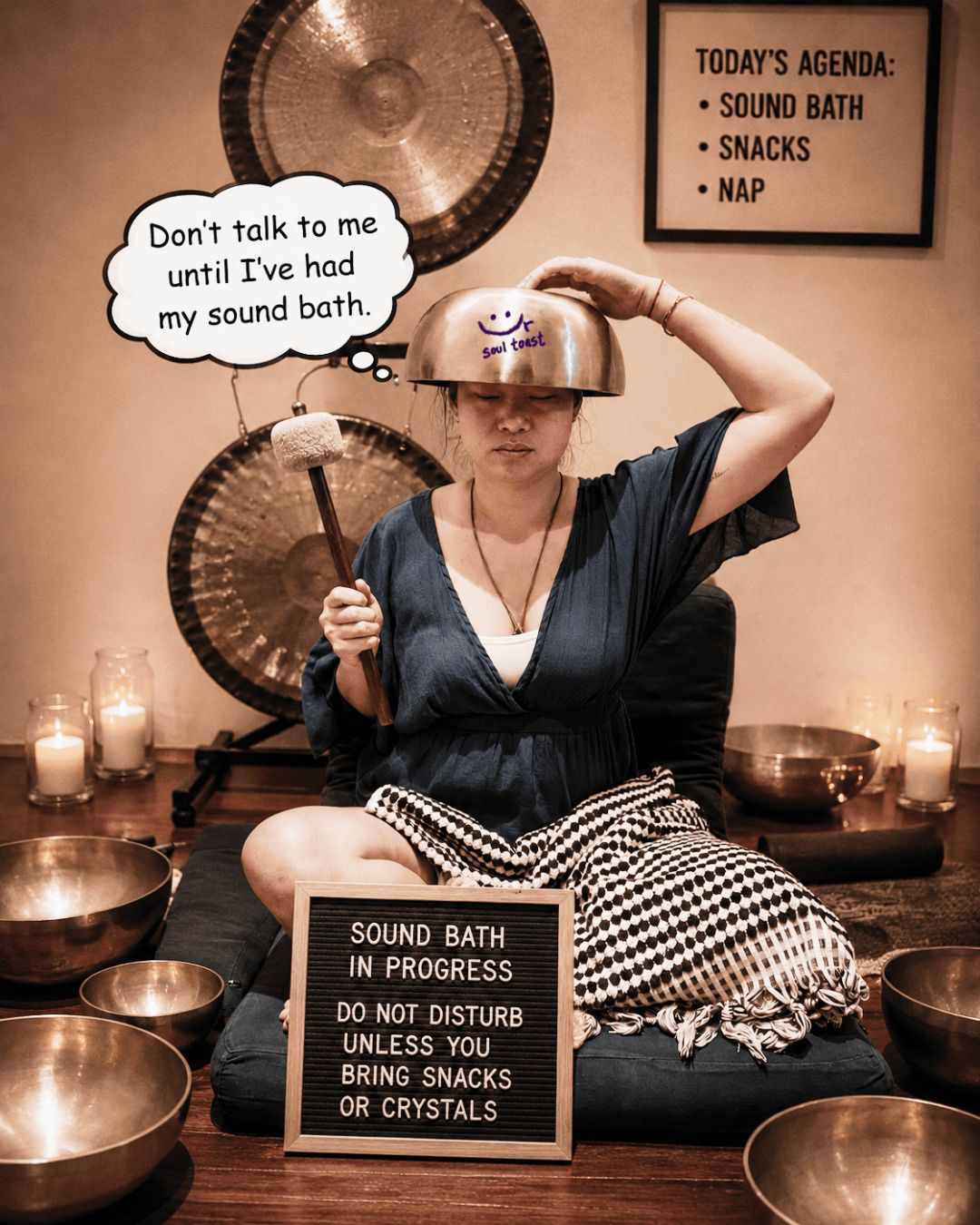
a sound bath is simpler: you lie down. sound moves through you. you don't have to do anything. it's a gentle, accessible entry point into receiving sound intentionally — not as background, but as the whole experience.
same instrument, different hands — what actually makes practitioners different
if you've browsed the singapore sound healing scene and felt mildly overwhelmed by how many options there are, you're not imagining the variety. sound baths happen in yoga studios, wellness centres, corporate spaces, and sacred circles. the person playing the bowls might be a yoga teacher, a classically trained musician, a certified sound therapist, or an expressive arts facilitator. the instruments can look identical from the outside.
so what's actually different?
two things, mostly: where they're coming from, and what they're trained to hold.
where they're coming from — many sound baths are offered by yoga teachers who have added sound certification to their practice. this is a natural pairing: yoga studios already have the space, the clientele, and the philosophy. sound fits. but in this context, sound often serves the yoga — a closer to savasana, a deepening of the asana practice. it's not the main event. it's the ending.
instrument specialists come from a different place — deep technical mastery of specific instruments, often with lineage training in gong, tibetan bowls, or crystal bowls. they understand resonance, frequency, and acoustic behaviour in a room. what they play is often precise, intentional, and beautifully skilled.
wellness and relaxation-focused practitioners offer something more accessible: come as you are, lie down, feel better. low barrier to entry, often great for beginners. the emphasis is on the outcome — rest, nervous system reset — rather than the framework underneath.
what they're trained to hold — this is the part that doesn't show up on the flyer.
musical training gives one kind of credibility. a practitioner who has spent years studying an instrument understands sound in ways others may not. but technical mastery of an instrument is not the same as knowing what to do when someone starts crying and doesn't know why. when sound does its job and something opens up in the room, the question is: who is trained to hold that?
this is the distinction i wrote about in what is expressive arts →: an artist and an art therapist are not the same person, even when working with the same materials. the artist brings skill to the medium. the therapist or facilitator brings skill — and a framework for what the medium stirs up.
the same is true in sound. the instruments matter. the person holding them matters just as much.
approach
what they bring
good for you if...
yoga-adjacent
sound woven into yoga framework, nada yoga lineage
you're a yoga practitioner wanting deeper savasana
instrument specialist
deep technical mastery, lineage-based training
you want precise, skilled vibrational work
wellness/relaxation
accessible, low barrier, nervous system reset
you're new to sound and want a gentle entry point
musically trained
acoustic knowledge, technical instrument skill
you want someone who really understands sound
therapeutically trained
relational holding, emotional processing framework
you're navigating something and need more than relaxation
expressive arts facilitated
sound as one modality within a broader therapeutic framework, emotionally integrative
you want the experience to mean something, not just feel something
live or recorded: what are you actually craving?
there's a difference between streaming a concert and being in the room.
anyone who has stood in front of a live band — felt the bass move through the floor, watched the musician's hands, been in a room full of strangers all moved by the same thing at the same time — knows that no recording quite captures it. research on live versus recorded music shows that live performance activates the vagal nervous system more, enhances the brain's synchronisation with sound, and produces stronger emotional responses. our bodies, it seems, know the difference.
the same is true for nature. watching a river on youtube versus standing at its edge with the sound of moving water, birds you can't name, leaves doing their thing in the wind — which one actually settles you? the recording is convenient. the real thing is something else entirely.
this is why i facilitate live, acoustic sound baths rather than playing recordings. when i am in the room with you, i am listening. the sound i make is in response to what i feel in the space. it adjusts. it breathes. a playlist cannot do that.
but recorded sound has its place too. the brown noise that helped me get through my worst months. the nature soundscape that gets you to sleep. these are not lesser — they are self-directed support, available whenever you need them. just a different thing.
chanting, mantra, hymns — what are you reaching for?
here is a question i find myself sitting with more and more:
when you close your eyes and chant a mantra, or sing a hymn, or listen to a buddhist heart sutra — are you moving toward something? or are you trying not to feel what's already there?
this is not a criticism. it's a genuine question i ask myself too.
sometimes sound is a doorway. sometimes it's a distraction dressed as a doorway. the difference is not in the chant itself — it is in what we're carrying when we enter it.
the om, the hallelujah, the arabic salawat, the confucian ritual music — these traditions understood something about the human nervous system before neuroscience had the language for it. repetitive, tonal, collective sound creates a physiological shift. it settles the mind. it opens something.
but what if what you're resisting isn't the religion itself? what if it's the feeling underneath — the one the chanting keeps just quiet enough to manage?
what are you rejecting? what are you reaching for? sometimes they are the same question.
expressing: the other direction
now flip it. instead of sound coming toward you, you are moving toward sound.
i love karaoke. not the polished kind — the belt-it-out, crack-on-the-high-note, sing-every-breakup-song-i-know kind. there is something that happens when you scream a lyric that names exactly what you've been holding and can't say out loud. the song does it for you, through you, at full volume. it's not pretty. it's not a performance. it's a release.
the handpan taught me something quieter but just as real. i had decided i wasn't musical — guitar hurt my hands, piano required two coordinated hands which mine refused to be, drumming made me feel like my brain was buffering. and then someone let me play a handpan. i didn't know what i was doing. i just touched it. and what came out was beautiful — not because of skill, but because the instrument doesn't punish you for not knowing the rules. it meets whatever you bring.
that was the moment i stopped thinking about sound as a performance and started understanding it as a language.
and then there is heavy metal.
growing up, my father played chinese new year music at full volume every morning. my brother's response was heavy metal. to me it was just: more noise. screaming. messy hair. tongues out. people rocking their heads in a way that looked like it should hurt.
it took years — and a lot of inner work — to be able to listen to it without flinching. and when i finally could, i heard something i hadn't expected: the lyrics. raw, dark, precise. linkin park was my entry point. sound of silence. heavy is the crown. duality. these are not songs about nothing. they are songs about the weight of being alive and not knowing how to say so.
and when i finally let go and screamed along — actually let my body do what the music was asking — something moved. something that had been stuck for a long time.
what therapists call sublimation — the way we channel what's hard to hold into something we can actually express — heavy metal does this viscerally. you are not suppressing the feeling. you are giving it somewhere to go. the anger, the grief, the frustration that has been sitting politely in your chest finally gets a container loud enough to hold it.
it is not my preferred genre. but i now understand why it is someone's everything.
and this, i think, is the whole point: there is no right sound. there is only what the feeling needs.
what words cannot hold
there is a song i used to listen to on repeat: how do i live without you?
for a long time i heard it as a love song about another person. i cannot live without you. i need you to survive.
but i heard it differently recently. what if the "you" is yourself?
how do i live without me?
how do i live when i have spent so long performing, shrinking, overriding what my body was trying to tell me — when i have outsourced so much of my inner knowing that i have lost the thread back to myself?
this is what i keep coming back to in expressive arts: sometimes the feeling is too large, too formless, too old for language. and what sound can do — whether you are lying in a sound bath, screaming in a ktv room, chanting in a temple, or touching a handpan for the first time — is give the feeling somewhere to land that is not a sentence.
you don't have to articulate it. you don't have to explain it. you just have to let the sound move through.
and the voice?
i've deliberately left one instrument out of this conversation.
your own.
that's the next post. because the voice deserves its own space and what it carries is something else entirely.
a quick reference: which one is for me right now?
what you're looking for
where to look
structured, clinical, goal-oriented work
music therapy: seek a credentialed therapist
targeted frequency work for a specific condition
sound therapy: ask about training
deep rest, no experience needed
sound bath
release, catharsis, expression of big feelings
whatever genre matches your inner weather.. go KTV la!
not sure yet
sound bath - definitely a gentle place to start
also on my blog...
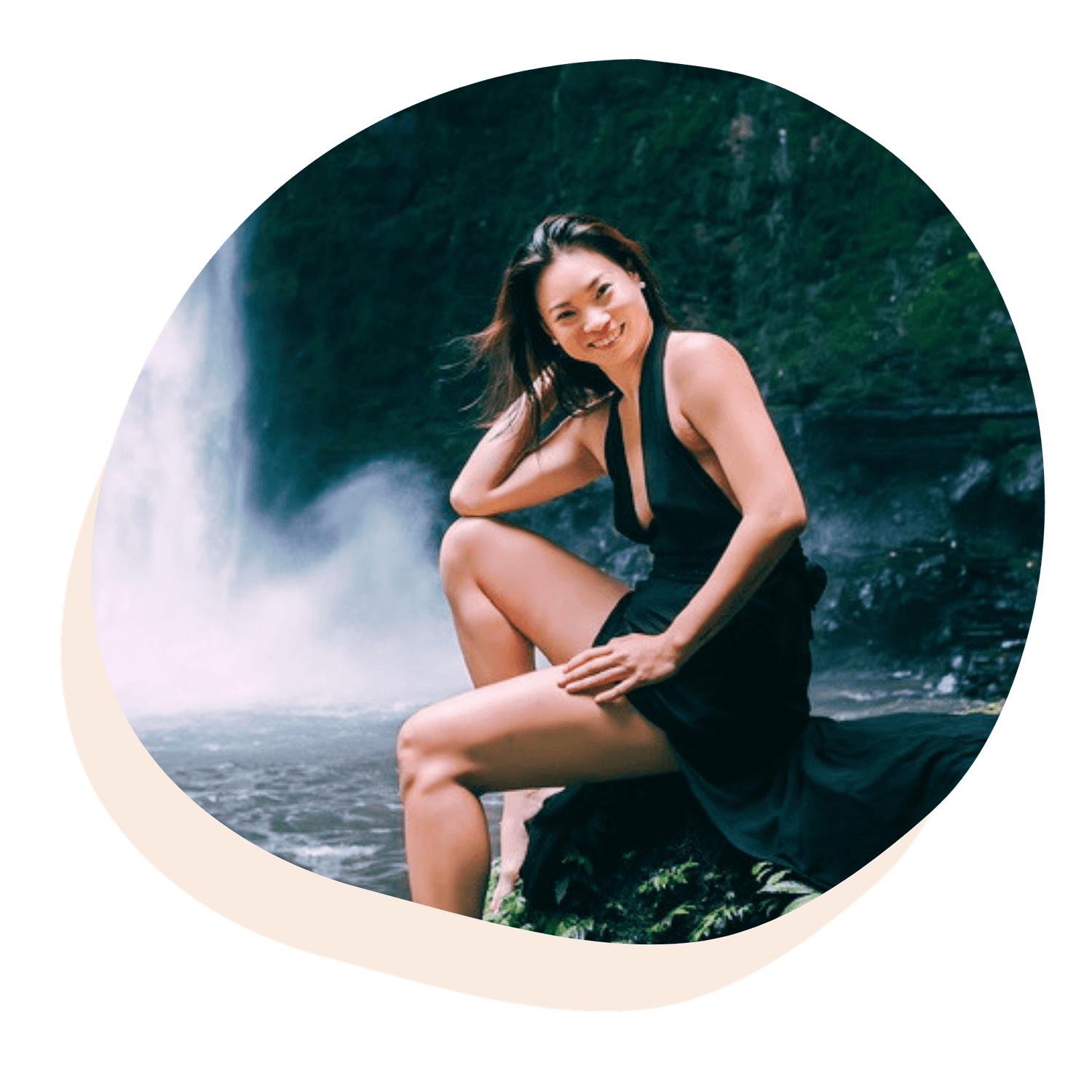
yello, i'm janelle!
an expressive arts facilitator who holds a gentle spaces for people to slow down, feel, and reconnect with themselves.
with a background in psychology, training in sound healing, expressive arts and movement, I weave in together sound, creativity and the body.. not as something to "perform", but as ways to safely explore and express what's भीतर (yes, even the messy parts)...
my approach is trauma-informed, consent-led, and shaped by lived experiences through burnout, loss, depression and rebuilding...
if you are looking for a space where you don't have to perform or have it all figured out, you've arrive.

follow me on IG or if you prefer to get updates via email:
sound baths · expressive arts · singapore
© 2026 ur soul toasted · ursoultoasted@gmail.com
All rights reserved. No part of this blog may be reproduced without written permission from the author.